


Authored by GoldFix
Citi says gold’s break below its 200-day moving average is a major warning sign, with prices potentially falling toward $4,000 before the next sustainable rally begins, even as the bank maintains a longer-term bullish outlook
Summary
Gold has broken below its 200-day moving average for the first time since 2023, prompting Citi to lower its three-month price target to $4,000 per ounce. While the bank remains bullish over a 6-12 month horizon, it argues that elevated energy prices, stronger U.S. economic data, and uncertainty surrounding the Strait of Hormuz create additional downside risk before a durable bottom is established.
“Dip buying here makes sense only with a strong view of no re-escalation of the war and resumption of Strait of Hormuz flows.”
Gold Breaks A Key Technical Level
Citi analysts are urging caution after gold closed below its 200-day moving average for the first time since September 2023, a development widely viewed by technical traders as a bearish signal. The bank responded by reducing its 0-3 month price target from $4,300 to $4,000 per ounce, arguing that momentum has deteriorated significantly following the metal’s retreat from record highs above $5,500 earlier this year.

According to Citi, the combination of strong U.S. employment data, rising real interest rates, and a stronger dollar has shifted the near-term balance of risks to the downside.
“The breakout below the 200dMA is widely considered a negative technical signal, which points to further downside potential in the near term.”
Energy Markets Are Driving The Narrative
A central theme throughout the report is the role of the Strait of Hormuz.
Citi argues that elevated energy prices resulting from the ongoing disruption have created a chain reaction across global markets. Higher energy costs have supported inflation expectations, reduced confidence in near-term Federal Reserve easing, strengthened the U.S. dollar, and pressured economic activity across energy-importing nations. All of those developments have created headwinds for gold.
The bank’s base case assumes that tensions eventually ease during the third quarter, allowing energy prices to move lower and relieving many of the pressures currently weighing on precious metals.
Citi’s Demand Calculation Raises Eyebrows
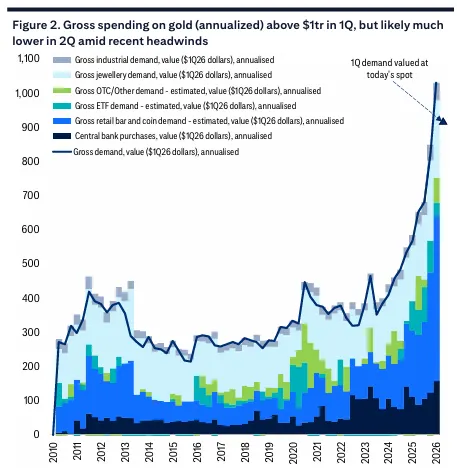
Perhaps the most interesting part of the report is Citi’s attempt to quantify how much buying is required to sustain current gold prices.
According to the bank, maintaining today’s valuation requires annualized gold demand approaching $900 billion. By comparison, annual demand during the 2010-2024 period generally ranged between $250 billion and $400 billion when adjusted into current dollars. Citi argues that if buying slows materially while geopolitical tensions remain elevated, gold could revisit levels near $3,500 per ounce.
In Citi’s framework, the current market requires an unusually large and sustained flow of capital to support present price levels.
“Physical gold buying is required to maintain a roughly $900 billion annual pace to sustain current prices.”
“Physical gold buying is required to maintain a roughly $900 billion annual pace to sustain current prices.”
Free Posts To Your Mailbox


