Why Does the Dollar Conversation Keep Returning to Gold?
Authored by GoldFix
Jamie Dimon was asked about the dollar’s reserve-currency status. He answered in part by defending foreign gold custody in New York. We thought that was a curious choice. His case for keeping the metal there was blunt:
“You’re not thinking clearly about safety. That gold is protected by the Atlantic, the Pacific, the United States military, the rule of law.”
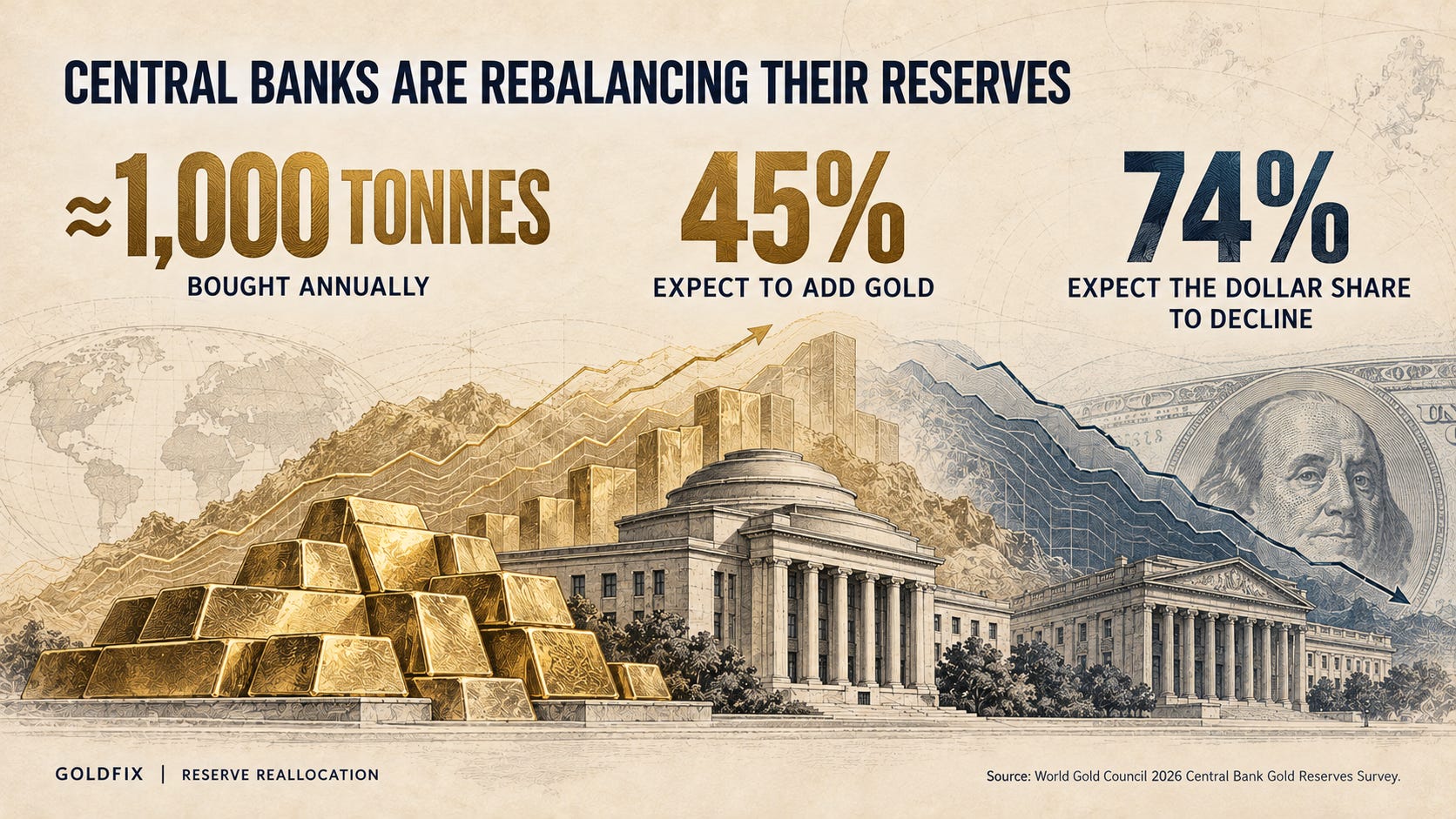
Dimon’s physical-security argument makes sense. Reserve owners also need to retrieve, sell or pledge their gold during a crisis. Access depends on laws, agreements and political decisions, and an owner can assess those risks differently from its custodian. Dimon acknowledged the political risk when he warned that American misuse of economic power could encourage countries to conduct business outside the dollar.Central banks have added roughly 1,000 tonnes a year over the past four years, according to the World Gold Council, about twice the preceding decade’s average. In its 2026 survey, 45% of respondents expected to increase their own gold holdings, while 74% expected the dollar’s share of global reserves to fall over five years. The buying is uneven across countries, but the aggregate increase has been substantial.
The Netherlands has already changed its custody arrangements. This year, DNB reduced the share of its gold held in New York from 31.3% to 18.5% and increased its London allocation. Total holdings remained unchanged. The bank cited geopolitical unrest, crisis preparedness and the ability to mobilize gold more readily. For us, the reduction in reliance on U.S. custody matters regardless of the destination.
France sold 129 tonnes held in New York between July 2025 and January 2026 and replaced them with gold held in Paris. Its stated purpose was to upgrade the bars to modern standards, and Governor François Villeroy de Galhau said the decision was not politically motivated. The change nevertheless removed that French gold exposure from New York.
Dimon Places Gold Repatriation in Debate Over U.S. Dollar Dominance
Jamie Dimon has floated $10,000 gold, and his defense of keeping foreign bullion in American vaults raises a question: what’s really at stake? Why use the location of bullion to make the case for the dollar’s staying power?
Germany transferred 300 tonnes from New York during 2013-16 and completed its wider repatriation program in 2017. It still held approximately 1,236 tonnes in New York at the end of 2025.
Gold has also made a substantial contribution to U.S. export receipts. BEA’s seasonally adjusted figures show approximately $74.5 billion of nonmonetary gold exports against $15.3 billion of imports in the first half of 2026. By our calculation, that produced a gold trade surplus of roughly $59.2 billion, helping offset deficits elsewhere in the current account. Exports continued into the summer, with the Census-basis category rising $2.3 billion in August from July.
We attach little importance to the “nonmonetary” label in assessing what those flows mean.
Full Analysis Here Tomorrow