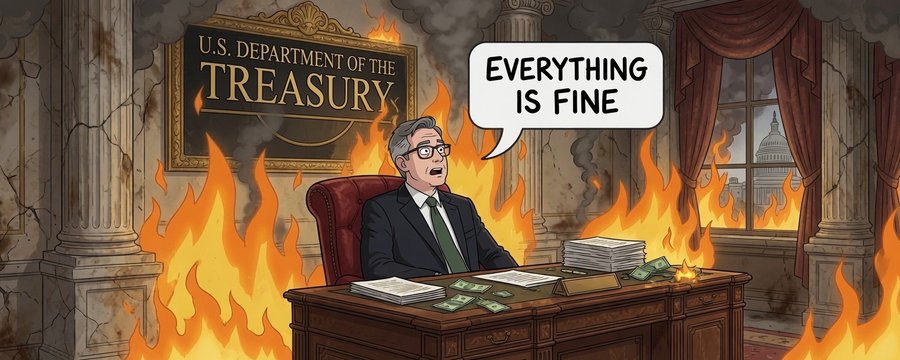
The Yen Carry Trade Is Breaking & Washington Just Stepped In

X
Facebook
LinkedIn
Reddit
Print
Email


Submitted by The Silver Wig:

The Japanese yen just hit a 40-year low near 164 to the dollar.

Tokyo and the U.S. Treasury responded with a rare joint intervention to buy yen and prop it up.

This is not a routine currency adjustment.
It is a symptom of deeper structural rot in one of the world’s most important funding markets – the yen carry trade – and it carries clear implications for global debt markets and hard assets.

The History of the Yen Carry Trade

For decades, Japan’s ultra-low interest rates turned the yen into the world’s favorite funding currency. After the 1990s asset bubble collapse, the Bank of Japan drove rates near zero and kept them there. Investors and hedge funds borrowed cheaply in yen, converted the proceeds into higher-yielding assets abroad – U.S. Treasuries, emerging-market bonds, equities, real estate, commodities – and pocketed the interest-rate differential.

This was the yen carry trade.

It exploded in the mid-2000s. By 2007, estimates put outstanding carry positions in the hundreds of billions. The strategy worked as long as the yen stayed weak or stable and Japanese rates remained suppressed.

The 2008 financial crisis forced a violent unwind: risk assets sold off, the yen surged as positions were closed, and leveraged players were crushed.

The trade revived after 2013 under Abenomics, when the BOJ doubled down on quantitative easing and yield-curve control.
Cheap yen funding once again lubricated global markets.

The pattern has been consistent: periods of calm and low Japanese rates encourage massive leveraged bets. Any sudden yen strength, rate hike, or risk-off shock triggers forced covering.

The latest rebuild of yen shorts reached levels last seen in 2007.
That crowded positioning is now colliding with Japan’s domestic realities.

Why the Yen Is Failing

Japan’s debt exceeds 200% of GDP — one of the highest ratios in the developed world.

Prime Minister Sanae Takaichi’s expansionary fiscal agenda, including large spending packages and defense outlays, is being financed with more Japanese government bonds. Markets correctly interpret this as more supply and higher long-term risk of monetization or inflation.

United States, preserving a wide interest-rate differential that favors shorting the yen. Persistent current-account dynamics, energy import dependence, and decades of monetary experimentation have left the currency structurally vulnerable. Speculators piled on.

Unilateral Japanese interventions earlier this year – sometimes in the tens of billions – failed to establish a durable floor.
The currency kept grinding lower until the latest breakdown forced coordinated action.

In short, the yen is failing because Japan’s fiscal path and still-accommodative monetary stance are incompatible with the scale of the carry trade and the reality of global rate differentials. Markets are pricing the risk that Japan cannot simultaneously expand fiscally, keep rates low, and defend its currency without consequences.

Why the U.S. Treasury Is Getting Involved

Japan is the largest foreign holder of U.S. Treasuries, with holdings in the $1.1–1.4 trillion range.
When Tokyo intervenes to support the yen, it typically sells dollar reserves. Those reserves are heavily invested in U.S. government debt. Large-scale sales would dump Treasuries into an already sensitive market, pushing yields higher and raising U.S. borrowing costs at a time of elevated deficits and already-firm long-term rates.

Washington has a direct interest in preventing that outcome. U.S. Treasury Secretary Scott Bessent has publicly described the yen as substantially undervalued and excess volatility as unhealthy. The risk of spillover — higher U.S. yields, tighter financial conditions, and potential disorder in the world’s benchmark debt market — is precisely why the Treasury has moved from verbal support to active participation. This is self-preservation as much as alliance management.

What the U.S. Treasury Is Doing

Last week, the United States and Japan conducted coordinated yen-buying intervention — the first joint yen-support operation in decades. Japan spent tens of billions; the U.S. side was smaller but symbolically powerful. Reports indicate the Federal Reserve Bank of New York acted on behalf of the Treasury, in some cases selling euros to buy yen.

Bessent confirmed the action, stated that Washington will not hesitate to participate in further joint intervention, and reiterated support for Japan’s market and monetary steps, including further Bank of Japan rate hikes.

Officials are also emphasizing the Fed’s Foreign and International Monetary Authorities (FIMA) repo facility. This allows Japan to obtain dollar liquidity against its Treasury holdings without outright sales, reducing the immediate pressure on the U.S. bond market. Both sides have signaled readiness for additional coordinated action if disorderly yen moves resume.

The message is clear: the United States will help stabilize the yen to protect its own debt market from Japanese reserve liquidation.

Why This Is a Bearish Signal for the Debt Market

The intervention itself is temporary. It does not resolve Japan’s fiscal trajectory or the underlying rate differential. Every major yen-defense operation raises the question of how it is funded. Even with FIMA backstops, sustained or repeated intervention still risks net sales or reduced demand for Treasuries from the largest foreign holder. Past interventions this year already coincided with drops in Japanese foreign-securities holdings and upward pressure on U.S. yields.

The deeper problem is structural. Japan’s expanding deficits and the potential for faster BOJ tightening (to support the currency) both point toward reduced Japanese demand for long-duration U.S. debt over time. Japanese investors have long been a steady bid for Treasuries.

Any shift — whether forced sales, repatriation, or simply less aggressive buying — forces other buyers to clear the market at higher yields. Higher U.S. funding costs feed back into weaker global risk appetite and further yen pressure, creating a feedback loop.

In plain terms: the world’s largest creditor to the U.S. government is under currency stress severe enough to require American intervention. That is not a sign of strength in the sovereign-debt complex. It is an admission that the machinery requires political overrides to keep functioning smoothly. Debt markets that depend on such coordination are more fragile, not less. Expect elevated volatility and a structural bias toward higher real yields until the underlying imbalances are addressed.

Why This Is Bullish for Precious Metals

Gold and silver thrive when confidence in managed fiat systems and sovereign debt frays. Coordinated interventions to prop a major currency and shield the Treasury market are textbook signals of stress.

They demonstrate that free-market pricing of the yen threatened broader financial stability, forcing official action. Repeated large-scale currency defense, fiscal expansion in high-debt economies, and explicit concern about Treasury-market spillovers all point to the same conclusion: the paper-money and debt system is under growing strain.

Historically, periods of aggressive official intervention, rising debt burdens, and currency crises have coincided with stronger long-term demand for hard assets. Gold and silver serve as residual stores of value outside the sovereign system. Central-bank accumulation of gold continues.

Physical market tightness, especially in silver, adds a structural floor. Short-term price action can be noisy — a stronger yen can temporarily firm the dollar and pressure metals priced in dollars — but the multi-year backdrop has improved. Labor pains in the yen-Treasury complex are the kind of alarm that historically precedes sustained precious-metals strength.

The carry trade is not dead, but it is under pressure.
The yen’s structural weakness, Japan’s fiscal path, and Washington’s decision to intervene all reveal the same underlying fragility. Debt markets are more exposed. Precious metals are better positioned as a result.

More from The Silver Wig:

GOLD & SILVER WILL RETURN TO THE MONETARY SYSTEM! 

Legendary Investor & Fund Manager Jim Rogers Explains that the ROYAL METALS ARE PREPARING TO RETURN TO THE MONETARY SYSTEM! 

 
🎙️Legendary investor & Fund Manger Jim Rogers joined the SilverTrade Insider for a MUST WATCH episode on what’s coming for gold and silver.


 
The man whose fund achieved an astonishing 4,200% return during the last precious metals bull market- a period in which the S&P returned 47% – weighs in on what he is doing RIGHT NOW after the first half’s brutal sell-off in precious metals.

Is Jim Rogers looking to SELL Gold & Silver, or BUY MORE!?

Get Smarter About
Silver & Gold

This is a staging environment