Submitted by The Silver Wig:
Why Comparing Silver’s 2026 Correction to 2011 Misses the Structural Reality
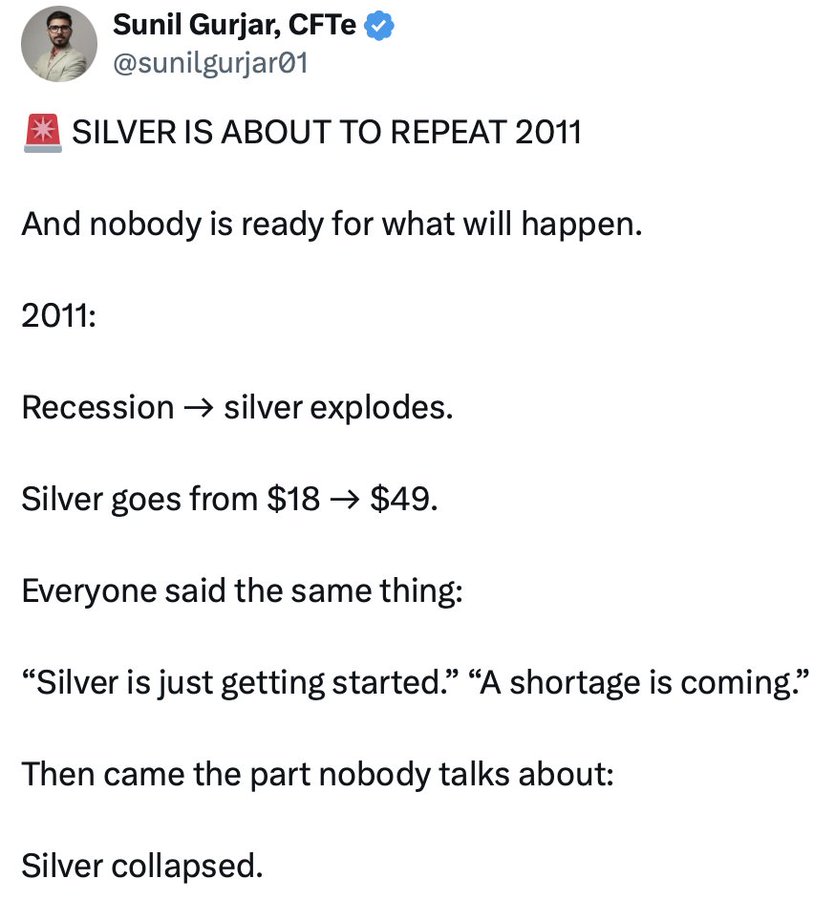
has repeatedly warned that “SILVER IS ABOUT TO REPEAT 2011!”
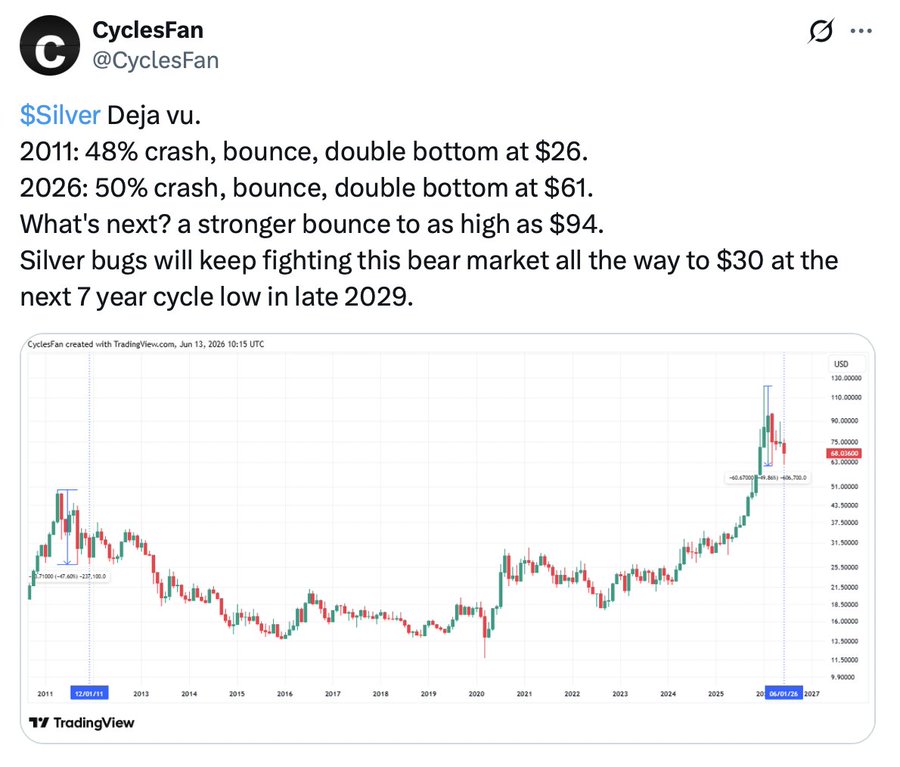
overlays the charts and declares “$Silver Deja vu.”
frames it as an inevitable pattern.
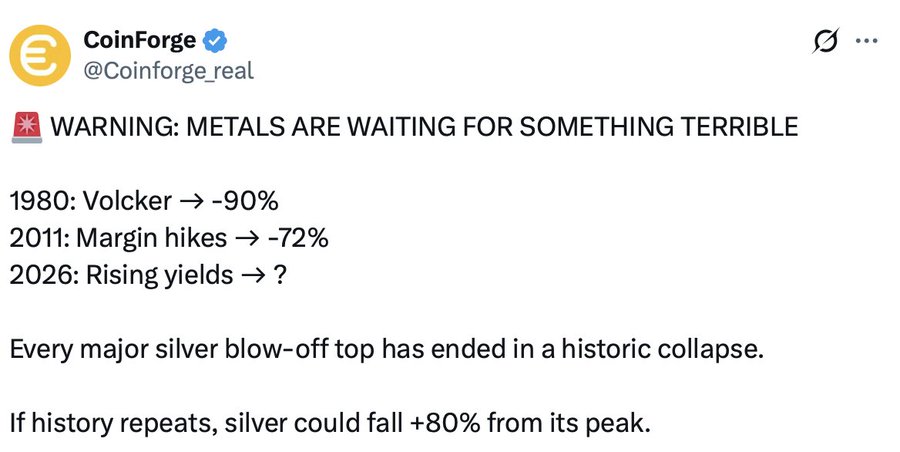
That analysis is thin.
It rests almost entirely on two historical patterns that occurred in fundamentally different eras, when governments and central banks still possessed ample room to defend fiat currencies through aggressive monetary expansion and when silver’s demand profile was dominated by investment and traditional fabrication rather than irreversible industrial consumption.
The structural, macroeconomic, and technological drivers operating in 2026 make a multi-year 2011-style suppression far less plausible.
The Narrow Historical Lens
Industrial offtake recovered from the recession but remained secondary. The market was roughly balanced or in mild surplus; mine production was still expanding modestly.
When the CME raised margins repeatedly in late April and early May 2011, leveraged longs were forced to liquidate, producing a rapid 30 percent-plus drop and setting the stage for a multi-year grind lower as stimulus expectations faded and the dollar strengthened.
The January 2026 spike occurred after silver had already broken the long-standing $50 nominal barrier on the back of physical tightness rather than pure liquidity.
The subsequent correction, while severe, has so far found support well above the multi-year pre-rally base.
Treating two peaks separated by 15 years as a deterministic template ignores the transformation of silver from a primarily monetary and jewelry metal into a critical industrial input whose supply cannot respond elastically.
Supply Constraints: Declining Ore Grades and Byproduct Inelasticity
Roughly 70 percent of output arrives as a byproduct of copper, lead-zinc, and gold mining.
Higher silver prices therefore do not automatically unlock large new primary supply; producers respond to the economics of the host metals.
Declining ore grades compound the problem. Miners must process ever-larger volumes of rock to extract the same quantity of silver, raising energy, capital, and environmental costs.
Primary silver projects remain limited, and the lead times from discovery to production stretch measured in years.
In 2011, production was still rising and grades had not yet deteriorated to the same degree. The supply response that eventually helped balance the market after 2011 is far more constrained today.
Demand Transformation: From Cyclical to Structural
Artificial-intelligence data centers and high-performance computing require silver’s unmatched electrical and thermal conductivity in specialized components and thermal interfaces.
Quantum-computing research and early commercialization pathways rely on silver in superconducting and interconnect applications. Robotics, advanced manufacturing, and automation systems embed silver in sensors, motors, and circuitry.
Space exploration and satellite constellations add incremental but high-value demand for radiation-resistant and high-reliability silver components.
These uses are not discretionary; they scale with the electrification and digitalization of the global economy. Unlike the investment-driven spikes of 2011, this demand does not vanish when monetary stimulus is withdrawn.
Persistent Deficits and Inventory Reality
Lease rates spiked to extreme levels during periods of tightness, signaling genuine physical stress rather than pure paper positioning. In 2011 the market did not enter the peak already running successive deficits of this magnitude. Inventory buffers that cushioned earlier cycles have been partially depleted.
Macro Backdrop: Unsustainable Debt and Policy Limits
However, Fed Chairman Kevin Warsh has proclaimed clearly,
“In periods of crisis, when markets aren’t clearing, I am willing to be quite aggressive in what the Fed does with its balance sheet.”
Government Policies, Export Controls, and Critical Minerals
Geopolitics and the Dual Nature of Silver
The paper market remains influential and capable of producing violent short-term swings, yet physical offtake and inventory dynamics increasingly set the longer-term floor.
Leverage Alone Does Not Dictate Outcomes
The 2011 collapse succeeded in part because the underlying balance was closer to equilibrium and monetary tailwinds were reversible. Today’s foundation is more durable.
The thinness of an analysis that relies primarily on two historical peaks from eras of greater monetary flexibility and weaker industrial intensity becomes apparent once the full set of structural forces is examined.
This cycle is different.
The combination of inelastic supply, expanding non-discretionary demand across green energy, AI infrastructure, quantum technologies, robotics, and space applications, persistent deficits, elevated debt burdens, and evolving policy frameworks creates a foundation that did not exist in 2011.
Price discovery will remain noisy, but the longer-term trajectory is shaped by physical realities rather than the temporary withdrawal of liquidity that defined the post-2011 decade.