


Whoever Owns the Physical Metal Will Reap the New Pricing Power
Why Tokenization Is (Very) Bullish for Physical
Whoever Owns the Physical Metal Will Reap the New Pricing Power
“Collateralizing physical Gold, Silver and commodities for liquidity is how human civilization has operated for thousands of years in most of human history.” -Eric Yeung
“Regardless of what happens, we expect the increased premium to accrue to usable metal and whoever controls it. “ -Vince Lanci
Contents
- Executive Summary
- Commodities Are Collateral
- Metal Has to be Unencumbered
- Rehypothecation Costs Money
- Ownership Raises the Price
- Futures Exchanges Have Risk
- Gold, Silver and Hong Kong’s Next Step
Executive Summary
By Vincent Lanci and Eric Yeung
We see the LME’s Hong Kong token plan as bullish for physical metal. Tokens would provide an enforceable record of who owns and who has pledged each tonne, so the market has to price the metal that is actually free instead of the gross warehouse number. Collateral use gives owners a second reason to hold, so anyone who wants the metal has to pay for its financing value as well as its industrial value. Whether rehypothecation shrinks or grows depends on the rules Hong Kong writes, but either way we expect the premium to accrue to usable metal and whoever controls it. Going forward from here, as the situation unfolds, we would watch physical premiums, lending rates, spot-futures spreads and the share of inventory pledged.
Intro:
The LME’s exploration of tokenized metal financing advances a development we have followed for years: physical commodities acquiring a larger role in the credit system. We see this as ultimately bullish for the metals involved. Their owners gain another reason to hold them, while enforceable ownership and pledge records can force markets to price the inventory actually available.
Reuters reported on October 28 that the London Metal Exchange, owned by HKEX since 2012, is exploring tokenization of off-warrant inventories in Hong Kong warehouses. The proposal would make that metal easier to use as loan collateral. The LME told Reuters:
“The LME is at the early stages of exploring the tokenization of off-warrant metal inventories to support financing of business.”
An industry roundtable is planned for early November. The rules are still being developed.[1]
As Eric says, “It is happening.”[2] The connection runs through collateral, the accounting of ownership, and the price required to persuade someone to release physical metal.
Commodities Are Collateral
In Vincent’s March 2022 discussion of Zoltan Pozsar’s Bretton Woods III, he concentrated on the observation that commodities are collateral and collateral is money. His concern was the amount of financial activity resting on physical assets that banks could become unwilling or unable to finance. He wrote:
“There isn’t enough good collateral out there for the size of potential claims being made on it.”
That article followed the problem into gold spread arbitrage, term funding and the relationship between spot and futures. A central bank can provide cash. Someone still has to supply acceptable metal, in the required form, at the required location.
Vincent’s work on the collateral pyramid examined how reuse allows a limited stock of assets to support successive layers of financing. The quantity of collateral and the permission to reuse it both matter. Restrict that permission and the same physical stock supports a different amount of credit.[3]
Hong Kong, Eric notes, is now pursuing infrastructure that puts those questions into commercial practice.
Inventory Has to Be Available
Off-warrant metal sits outside the LME warrant system. It can already have an owner, documentation and financing arrangements. The proposal addresses the absence of a standardized financing mechanism for that inventory.[1]
As Eric puts it:
“Digital tokenization and blockchain are the enforcer and the lever that will ensure the system does not collapse under its own weight the way it has many times throughout history.”
A useful tokenized system would connect an identifiable parcel of metal to its owner, custodian and existing pledges. Physical verification establishes that the metal exists. Enforceable records establish who can transfer it, borrow against it or authorize its release. Both are necessary.
Consider a warehouse containing 100 tonnes. If 70 tonnes secure loans under arrangements requiring repayment or substitute collateral before release, the warehouse still contains 100 tonnes. Only 30 tonnes are immediately unencumbered. A buyer seeking more must offer terms that induce an owner to unwind financing or find replacement collateral.
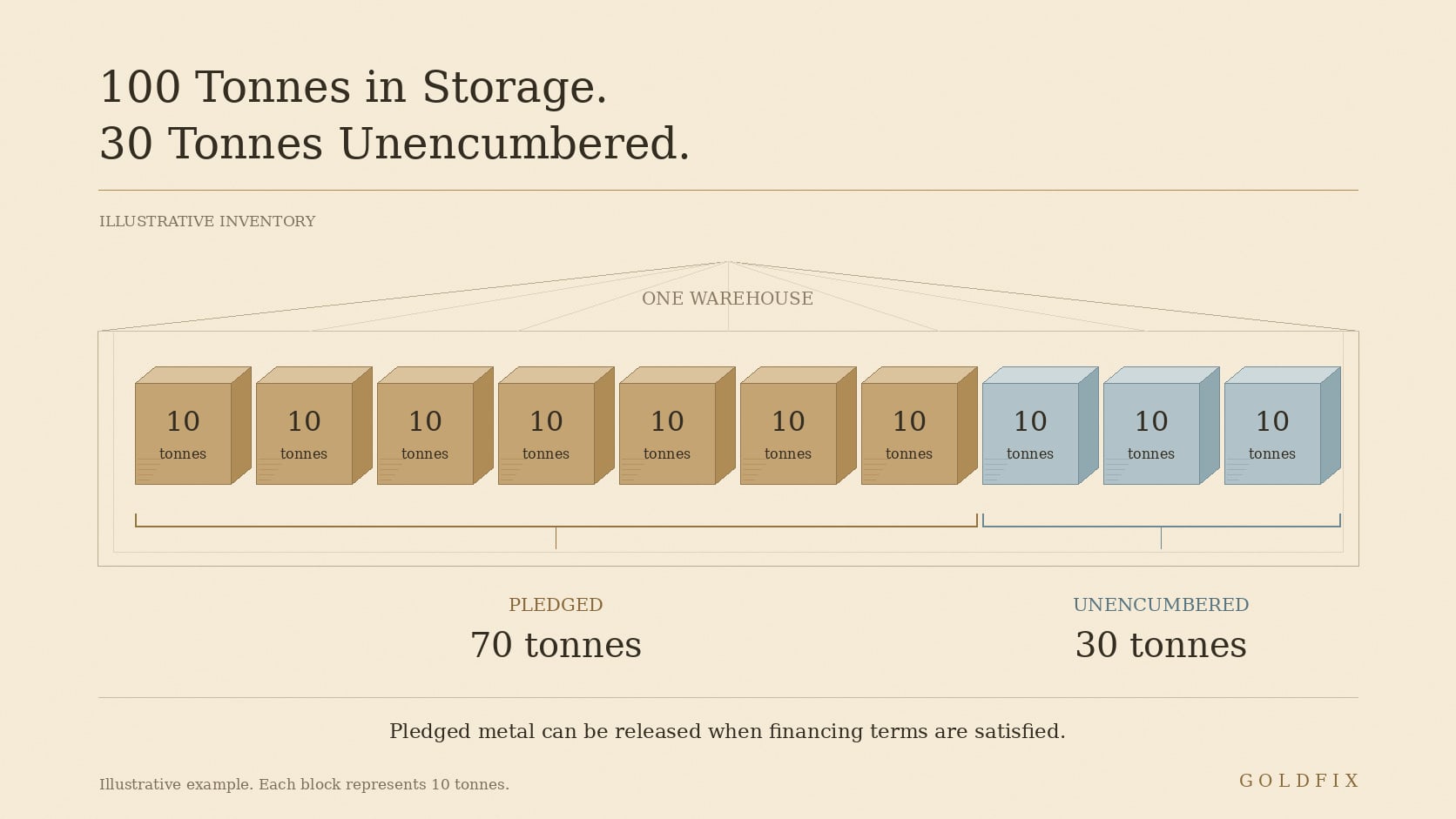
That is true inventory accounting. Gross warehouse stocks, pledged stocks and freely available stocks become distinct quantities. A borrower’s metal remains an asset where the accounting rules permit, with the associated debt and restrictions properly recognized. Creating a token representing that metal adds a record of rights; it creates no additional tonne.
For a lender assessing a balance sheet, the difference is material. The useful figure is the collateral it can actually recover after prior claims and applicable discounts.
The Rehypothecation Question
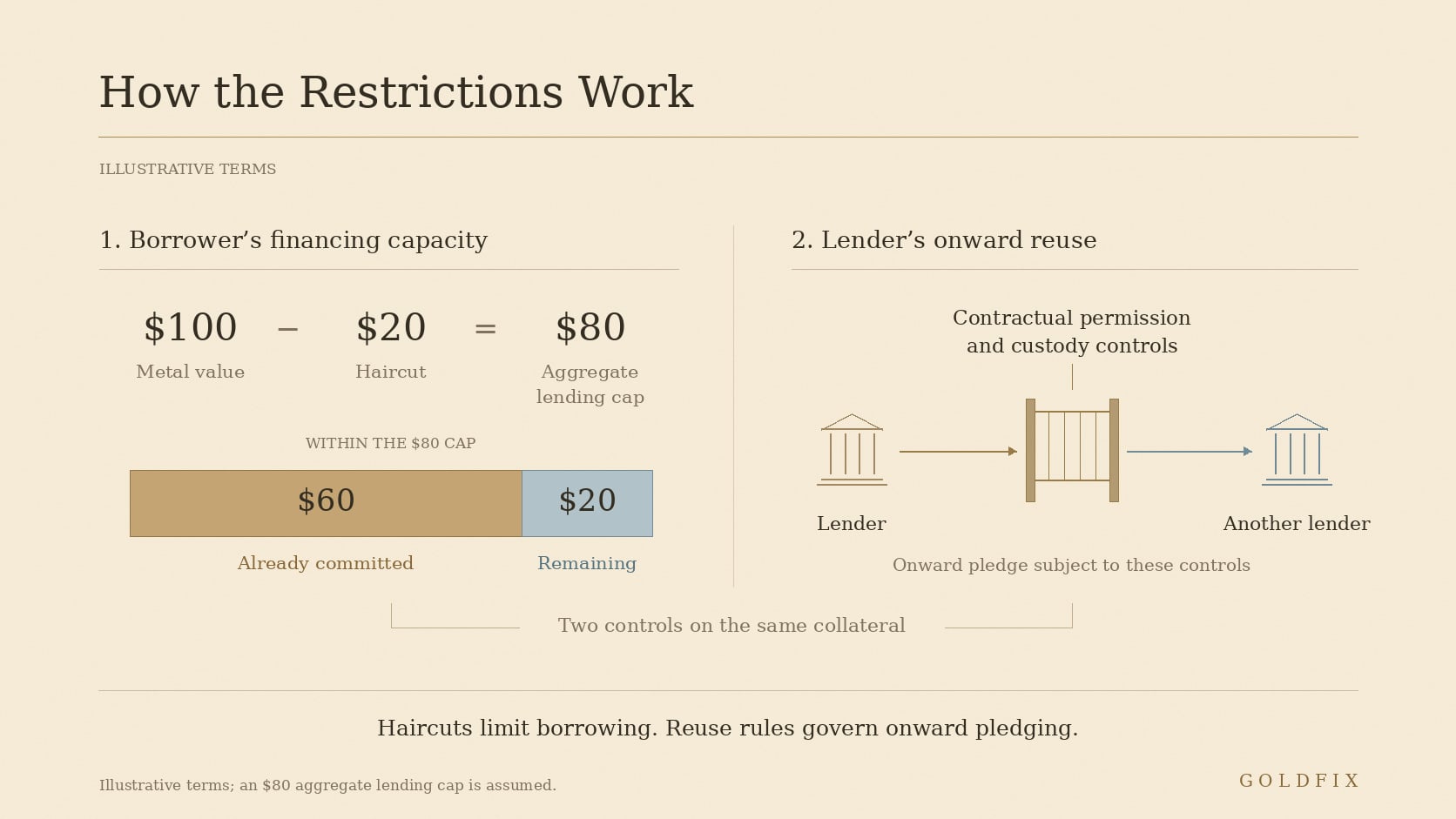
Rehypothecation is a lender’s reuse of collateral received from a borrower. Restricting it requires enforceable lending and custody rules. Recorded ownership and liens let those rules be applied to identifiable metal.
Haircuts limit borrowing capacity. Consider a mortgage-style arrangement in which $100 of metal carries a 20% haircut and an $80 aggregate lending cap. An existing $60 lien leaves $20 of additional capacity. Recorded liens establish priority among lenders; custody controls prevent unauthorized release. Restricting rehypothecation also requires limits on the lender’s own right to pledge the metal onward. Haircuts alone leave that right intact. Together, these controls limit borrowing against already-encumbered inventory and the reuse of collateral received.[4]
China’s traditional banks have historically placed substantial weight on property and other collateral in small-business lending.[5] We see verifiable metal inventories broadening the assets that can support this lending practice, giving physical ownership another source of financial value.
The “death of rehypothecation” argument therefore depends on these controls. More inventory can become financeable while less remains available for unrestricted reuse. Hong Kong’s final rules determine the outcome; as the BIS notes, tokenization can also facilitate reuse when permitted.[6]
Ownership Changes the Price
Industrial demand already gives metal a reason to be held. Collateral use adds another. An owner who can finance a business against inventory has greater flexibility to retain it, and a buyer must compensate that owner for giving up the metal’s financing usefulness as well as its industrial value.
This is where restrictions on competing claims improve price discovery. An already pledged tonne must be released, substituted or priced accordingly before another party can obtain unrestricted control. Markets have to distinguish the price of exposure from the price of available material.
We expect that distinction to favor physical commodities as this infrastructure develops. Financial demand gains a more direct route into inventory, while stronger ownership controls limit the amount of apparently available supply that competing claims can represent. The bullish force is the combination of greater usefulness and a clearer accounting of scarcity.
Continues here


