Authored by GoldFix
One could say the Goldman Sachs report describes central banks increasingly buying gold “under the radar,” as sovereign purchases appear to be disappearing from traditional UK trade statistics even while London vault outflows continue rising. The bank’s revised methodology effectively argues that official-sector demand remains stronger than publicly visible data had suggested.
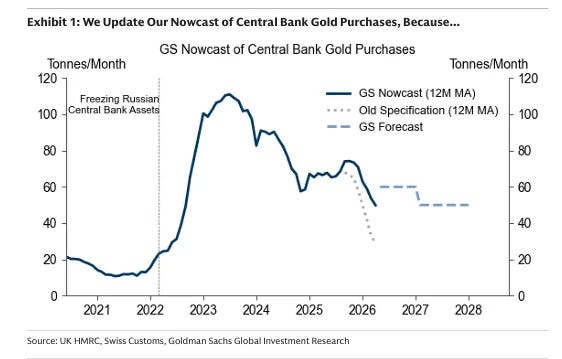
Goldman Sachs in a special weekend note1 believes central bank gold demand has remained materially stronger than previously estimated, even as publicly visible purchase data appeared to slow over the past year. In a precious metals note, Goldman Sachs analysts Lina Thomas and Daan Struyven revised the bank’s proprietary central bank nowcast higher after identifying what they describe as “missing sovereign flows” in London gold trade data.
The bank’s updated 12-month moving average estimate for central bank purchases now stands at 50 tonnes per month in March, versus just 29 tonnes under the prior model. Goldman also reiterated its $5,400 per ounce end-2026 gold target, arguing that underlying reserve diversification demand remains intact despite short-term volatility risks.
“Recent geopolitical developments are likely to reinforce diversification over time — both for central banks and private investors.”
The report centers on London’s role in the global gold market. Because London OTC is the primary venue where sovereign entities transact in large size, Goldman attempts to infer central bank purchases using UK customs and vault-flow data. Since the UK produces virtually no deliverable gold domestically, imported gold must either remain in London vaults or leave the country through exports.
Historically, UK net exports closely tracked observable London vault outflows, which suggested sovereign gold transactions were still effectively appearing in customs statistics despite international guidance recommending sovereign gold remain excluded from trade reporting.
That relationship broke down beginning in August 2025.
Goldman now observes that London vault inventories continue declining while official UK export data no longer fully reflects those outflows. According to the bank, the discrepancy likely represents sovereign gold movements increasingly disappearing from trade statistics altogether. Somebody is getting more gold delivered than we know.
“This suggests that some portion of sovereign transactions is no longer being recorded.”
Free Posts To Your Mailbox